
Find your solution
Diagnosis.
Overview
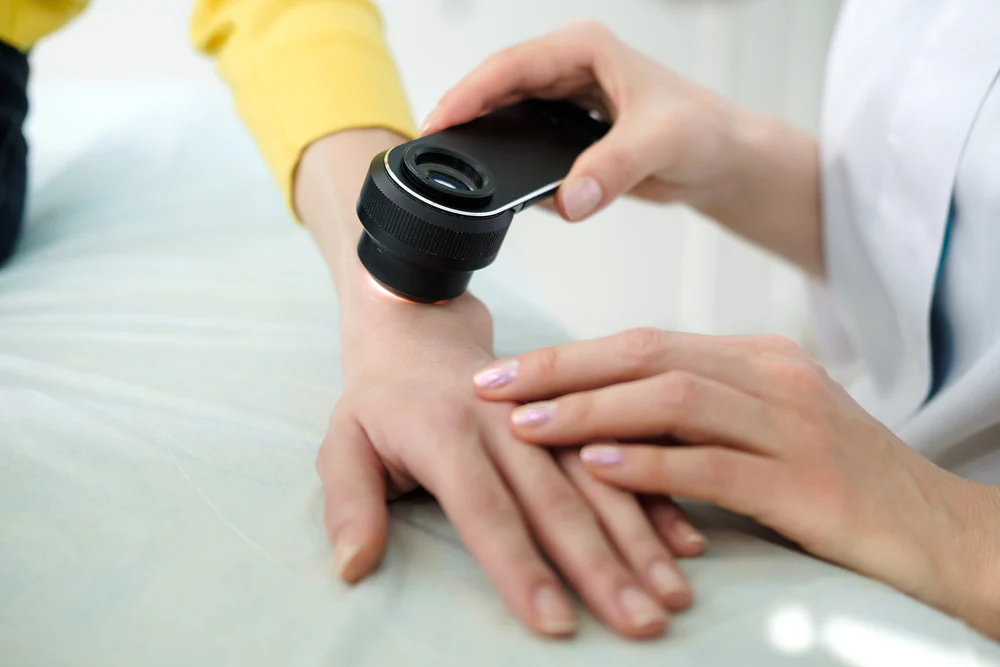
We provide expert visual diagnosis for skin lesions, supported by high-quality dermoscopy. Dermoscopy significantly improves diagnostic accuracy, offering a more reliable assessment than visual examination alone.
Why Choose Our Service?
• GPs: Typically achieve a diagnostic accuracy of 50–72% for skin lesions.
• Dermatologists: Accuracy increases to 90% with experience, especially when using dermoscopy.
• NHS waiting times for non-urgent appointments are substantial.
• Current private dermatology appointments are approximately 150% more expensive.

What we offer
• A detailed dermatology report from a qualified and experienced consultant dermatologist.
• Advanced Dermatascope: 25 LEDs, 10x Magnification, Variable-Polarisation, PigmentBoost, UV. Cross-polarised and non-polarised highlight skin layers by scrolling through the entire polarisation range.
• A clear medical opinion on your lesion and in-report guidance if further investigation is required.
• No less than two people see your report before you receive it.
• An assessment for viable treatments and, if the lesions are something we can address, all documents for viable treatment options.
If additional evaluation is necessary, you can share the report directly with your GP for appropriate follow-up.
What we do not offer
• Biopsy.
• Histology.
• More than nine lesions diagnosed at any one time.
Your Journey
Click to view your journey
Day 1
Diagnosis appointment
• Advanced Dermatascope: 25 LEDs, 10x Magnification, Variable-Polarisation, PigmentBoost, UV. Cross-polarised and non-polarised highlight skin layers by scrolling through the entire polarisation range.
• An assessment for viable treatments and, if the lesions are something we can address, all documents for viable treatment options.
Providing as much information as we reasonably can so you can make an informed choice.
Day 2
Diagnosis Report
• A detailed dermatology report from a qualified and experienced consultant dermatologist.
• A clear medical opinion on your lesion and in-report guidance if further investigation is required.
• No less than two people see your report before you receive it.
If additional evaluation is necessary, you can share the report directly with your GP for appropriate follow-up.
Day 4
Treatment Options
You will receive two documents via email within 5 days for your first appointment:
• Elective document listing your pre-care, after-care, healing exceptions, and potential risks.
• Quotes for all viable treatment options that we provide.
*please know that we address most, but not all lesion types/locations
Day 5
Elective Treatment
In the documents received there will be a direct booking link for the treatment option(s) available. simply click and book at your convenience.
Day 6-28
Support
We will be on hand via phone and email for any questions or support that you may have during your healing process. You also have use of the 24hr emergency contact number.
Day 29
Follow-Up
We offer a free follow-up appointment 4-6 weeks after your treatment, this is to ensure that you are healing as expected and to asses for sings of recurrence.
*standard cancelation policy still applies.
Helpful Information
Terminology
Dermoscopy
- A dermatoscope is a handheld device with a magnifying lens that takes high-resolution photos of the skin
- Dermoscopy can be used to visualize subsurface colors, structures, and patterns
- Dermoscopy can help differentiate between melanocytic lesions and non-melanoma skin cancers
Biopsy
A biopsy is a medical test where a small piece of tissue or cells is removed from the body to be examined under a microscope. It helps diagnose diseases or conditions, like cancer or infections.
Examples:
•Skin biopsy: Taking a small sample of a suspicious mole or rash.
•Liver biopsy: Removing a tiny piece of liver tissue to check for damage or disease.
Benign
Benign means something is not harmful or dangerous. In medical terms, it often refers to growths or tumours that won’t spread or cause serious problems.
Examples:
•Benign tumour: A non-cancerous lump like a lipoma (fatty growth).
•Benign mole: A harmless spot on the skin.
Malignant
Malignant means something is harmful, dangerous, or likely to spread and cause damage. In medical terms, it often refers to cancerous growths that can invade nearby tissues or spread to other parts of the body.
Examples:
•Malignant tumour: A cancerous growth, like melanoma (skin cancer).
•Malignant cells: Abnormal cells that grow uncontrollably.
Histology
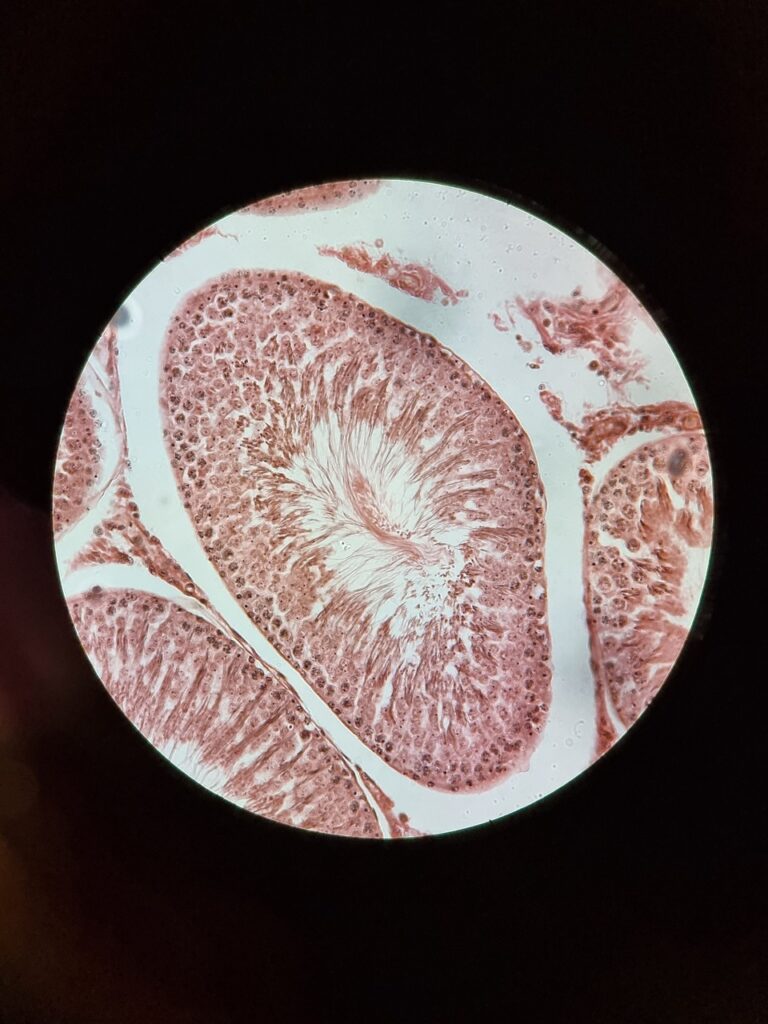
Histology is the study of tissues under a microscope to look for signs of disease or how tissues are structured and working.
Examples:
•Checking a biopsy sample for cancer cells.
•Studying skin tissue to identify a rash’s cause.
Keratosis
A skin condition with thick, rough patches caused by excessive keratin.
Examples:
Seborrheic keratosis: Benign, wart-like growths often called “age spots.”
Actinic keratosis: Pre-cancerous, scaly patches from sun damage.
Further information: NHS, British Association of Dermatologists.
Actinic
Actinic refers to skin changes caused by sun exposure.
Examples: Actinic keratosis (sun damage spots that can become cancerous).
Further Information: NHS, British Association of Dermatologists.
Cherry Angioma
Cherry Angiomas: small, bright red bumps made of blood vessels.
•Also known as: Senile angiomas.
Further information: Healthline, Dermnet
Skin Tags
Skin tags are soft, harmless growths of skin hanging on a stalk or having a wider contact base.
•Also known as: Acrochordons.
Further information: NHS, Patient Info
Warts
Warts: small, rough bumps caused by the human papillomavirus (HPV).
•Types: Common, plantar (foot warts), and flat warts.
Further information: NHS, Cancer Research UK
Keloid Scars
Keloid Scar: A thick, raised overgrowth of scar tissue that extends beyond the original wound.
•Caused by: Excess collagen production during healing.
•Common areas: Chest, shoulders, earlobes, and back.
•Also known as: Keloidal scar.
•Difference from hypertrophic scar: Keloids grow beyond the wound; hypertrophic scars stay within it.
Further information: NHS, British Association of Dermatology
HPV
A virus causing warts or sometimes, in some varints such as linked to cancer such as HPV types 16 and 18 are the two most common types of human papillomavirus (HPV) that cause cancer. Other high-risk HPV types include 31, 33, 35, 39, 45, 51, 52, 56, 58, and 59
There are over 200 types of HPV
•Full name: Human papilloma virus.Further information: WHO, Cancer Research UK
Hyperpigmentation
Dark patches of skin caused by excess melanin.
Examples: Melasma, dark spots, or post-inflammatory marks.
Further information: HealthLine, Changing Faces.
Hypopigmentation
Light or white patches of skin due to low melanin.
Examples: Vitiligo or scars.
Further information: HealthLine, NIH.
Comedone
Comedone is a clogged pore in the skin.
Examples:
Blackheads (open comedones).
Whiteheads (closed comedones).
Further information: British Association of Dermatology, HealthLine.
Dysplasia
Abnormal changes in cells that could lead to cancer.
Examples: Dysplastic nevi (irregular moles).
Further information: British Association of Dermatologists
Xeroderma
Very dry skin, often rough and scaly.
Also known as: Xerosis.
Further information: NHS, British Association of Dermatology.
Telangiectasia
Telangiectasia, a mmall, visible, broken blood vessels on the skin.
•Also known as: Spider veins.
Further information: NHS
Xanthelasma
Xanthelasma: Yellowish patches of fat under the skin, usually around the eyes. Typically, there is a degree of symmetry in both periorbital sockets.
•Common in: High cholesterol conditions.
Further information: Heathline, Patient Info
Papiloma
Papilloma: A small, benign tumour caused by an overgrowth of epithelial tissue.
•Examples: Warts or skin tags.
Further information: WHO, Cancer Research UK
Hemangioma
A birthmark, lump, or growth formed by extra blood vessels.
•Also known as: Strawberry marks (in babies).
Further information: Patientinfo, British Association of Dermatology.
Erythema
Red skin caused by increased blood flow, typically followed by trauma.
•Examples: Sunburn or skin irritation.
Pruritus
Dermatitis
Inflammation of the skin causing redness and irritation.
•Examples: Atopic dermatitis (eczema) or contact dermatitis.
Further information: NHS, British Association of Dermatology
Eczema
Dry, itchy, and inflamed skin, often triggered by allergens or irritants.
•Also known as: Atopic dermatitis.
Further information: NHS, National Eczema Association
Lichenification
Thickened, leathery skin from repeated scratching or irritation.
Further information: Healthline, NIH
Treatments
Microplasma
Microplasma is a cutting-edge, non-surgical treatment for skin lesion removal and skin tightening. Using controlled plasma energy, this technology safely ablates unwanted skin tissue while stimulating collagen production, making it an excellent alternative to traditional electrosurgery.
Further info:
Biopsy
A biopsy is a medical test where a small piece of tissue or cells is removed from the body to be examined under a microscope. It helps diagnose diseases or conditions, like cancer or infections.
Examples:
•Skin biopsy: Taking a small sample of a suspicious mole or rash.
•Liver biopsy: Removing a tiny piece of liver tissue to check for damage or disease.
Benign
Benign means something is not harmful or dangerous. In medical terms, it often refers to growths or tumours that won’t spread or cause serious problems.
Examples:
•Benign tumour: A non-cancerous lump like a lipoma (fatty growth).
•Benign mole: A harmless spot on the skin.
Malignant
Malignant means something is harmful, dangerous, or likely to spread and cause damage. In medical terms, it often refers to cancerous growths that can invade nearby tissues or spread to other parts of the body.
Examples:
•Malignant tumour: A cancerous growth, like melanoma (skin cancer).
•Malignant cells: Abnormal cells that grow uncontrollably.
Histology
Histology is the study of tissues under a microscope to look for signs of disease or how tissues are structured and working.
Examples:
•Checking a biopsy sample for cancer cells.
•Studying skin tissue to identify a rash’s cause.
Dermoscopy
- A dermatoscope is a handheld device with a magnifying lens that takes high-resolution photos of the skin
- Dermoscopy can be used to visualize subsurface colors, structures, and patterns
- Dermoscopy can help differentiate between melanocytic lesions and non-melanoma skin cancers
Biopsy
A biopsy is a medical test where a small piece of tissue or cells is removed from the body to be examined under a microscope. It helps diagnose diseases or conditions, like cancer or infections.
Examples:
•Skin biopsy: Taking a small sample of a suspicious mole or rash.
•Liver biopsy: Removing a tiny piece of liver tissue to check for damage or disease.
Benign
Benign means something is not harmful or dangerous. In medical terms, it often refers to growths or tumours that won’t spread or cause serious problems.
Examples:
•Benign tumour: A non-cancerous lump like a lipoma (fatty growth).
•Benign mole: A harmless spot on the skin.
Malignant
Malignant means something is harmful, dangerous, or likely to spread and cause damage. In medical terms, it often refers to cancerous growths that can invade nearby tissues or spread to other parts of the body.
Examples:
•Malignant tumour: A cancerous growth, like melanoma (skin cancer).
•Malignant cells: Abnormal cells that grow uncontrollably.
Histology
Histology is the study of tissues under a microscope to look for signs of disease or how tissues are structured and working.
Examples:
•Checking a biopsy sample for cancer cells.
•Studying skin tissue to identify a rash’s cause.
Risks
FAQ
Popular Pages
Consultation
The first step in making an informed choice. Know what it is, what is available, what are the risks and costs.
Teledermoscopy
Dermatologists diagnosis using the latest devices and software to take images of your lesions.
Photos
With over 30,000 photos of past clients, we are in a good position to provide a little insight as to what to expect.
Microplasma
In the same category as Diathermy and Fibroblasting, addressing skin lesion with up to 0.01mm precision.
Cryosurgery
The go to treatment option for the NSH for 70 years, Cryotherapy/Cryosurgery is well suited for many skin lesions.
Consultation
The first step in making an informed choice. Know what it is, what is available, what are the risks and costs.
Anti-wrinkle
Used to address fine line, deeper line, asymmetry, excessive sweating, headaches, teeth grinding and more.
Skin Boosters
Moisturised from the inside out! polynucleotides, low molecular weight hyaluronic acid, amino acids. The science of turning back the clock.
Body Contouring
Addressing stubborn areas of concern such as loose skin or fat deposits.
Consultation
The first step in making an informed choice. Know what it is, what is available, what are the risks and costs.
Blood Testing
With a extensive range of biomarkers and packages available to suit your needs. Get your results within 24-36 hours.
Phototherapy
Regulation of Melatonin, Increase in Serotonin, Balancing Dopamine there are many benefits to phototherapy, it helps more than just skin.
Vitamins
Vitamin injections. We can provide a range of vitamins including B12, D, C, and H.
Consultation
The first step in making an informed choice. Know what it is, what is available, what are the risks and costs.
Stretch Marks & Scars
Though there is no quick fix, we are able to address a broad range of stretch marks and scaring, providing a treatment plan for improvement.
Skin Concerns
Contact Dermatitis, Psoriasis, Acne, Block Pores, Hyperpigmentation. Have a conversation about your potential options
Facials
All tailored, each targeted. If you need to look good for a conference the next day or you want to address a deeper concern.
Home Courses
Affordable online courses aimed at assisting you in achieving the most our of your business and your treatments.
Advanced Courses
Small group for face to face advanced training. Course subjects includes: Aesthetic Treatments, Client Management, Business Development, Business Automation, Business Strategy, Competition Analysis and more.
Closed Training
Private training for companies and their staff.
Consultation
Have you had an aesthetics consultation with us before? We can not proceed with treatment without a prior consultation.
Diagnosis
You need a diagnosis, we can do this for you or you gan have it elsewhere such as NHS.
Teledermoscopy, a visual dermatologist’s diagnosis using the latest devices and software to take images of your lesions.
You can have a lesion of concern diagnosed by your GP, pharmacist, or NHS services.
Book a treatment consulation before your diagnosis. Note: we will not be able to proceed with treatment until you have your diagnosis.
Appointment Options
As you have already had a your lesion checked and confirmed benign you do not need it diagnosed again, please choose one of the following:
30-minute in-depth consultation. Get to know and discuss your options thoroughly so you can make an informed choice. And if we can’t help, we will point you in the right direction with contacts if possible.
Quick 5-minute assessment of the lesions to assess if it is something that we can address or not.
Appointment Options
We are unable to carry out any treatment until you have a diagnosis, though you till have options.
30-minute in-depth consultation. Get to know and discuss your options thoroughly so you can make an informed choice. And if we can’t help, we will point you in the right direction with contacts if possible. Diagnosis not included.
Quick 5-minute assessment of the lesions to assess if it is something that we can address or not. Diagnosis not included.
Existing Client
We aim to send your documents to your email address within seven working days of your consultation. These documents also contain your direct booking link for your appointment.
If you are having trouble, please email customer services Contact@cambridgecontourclinic.com
Local GP
Use the following link to find a local GP to diagnose your skin lesion of concern: https://www.nhs.uk/service-search/find-a-gp/
Welcome back
Thank you for choosing us again.
We strongly recommend booking an in-depth consultation if you would like to have a treatment that you have not discussed or had with us before.
Repeating a treatment, or assured that you do not need to discuss a new treatment with us? Use this link to explore our services.
Welcome back
We strive to help you make an informed choice, ensuring we provide the right treatment for your concerns while prioritising your safety and satisfaction with the outcome.
A quick 15-minute appointment to asses your situation and update your details.
If you would like to have a treatment that you have not discussed with us before, we strongly recommend booking an in-depth consultation; we can update your details at the same time.
Appointment Options
We strive to help you make an informed choice, ensuring we provide the right treatment for your concerns while prioritising your safety and satisfaction with the outcome.
New client registration and assessment.
Get to know and discuss your options thoroughly so you can make an informed choice. And if we can’t help, we will point you in the right direction with contacts if possible.
Consultation
We strive to help you make an informed choice, ensuring we provide the right treatment for your concerns while prioritising your safety and satisfaction with the outcome.
30-minute in-depth consultation. Get to know and discuss your options thoroughly so you can make an informed choice. And if we can’t help, we will point you in the right direction with contacts if possible.
Book a treatment consulation before your diagnosis. Note: we will not be able to proceed with treatment until you have your diagnosis.
Appointment Options
We strive to help you make an informed choice, ensuring we provide the right treatment for your concerns while prioritising your safety and satisfaction with the outcome.
30-minute in-depth consultation. Get to know and discuss your options thoroughly so you can make an informed choice. And if we can’t help, we will point you in the right direction with contacts if possible.
5-m
Quick 15-minute assessment of your concern to assess if it is something that we can address or not.
Diagnosis
You need a diagnosis, we can do this for you or you gan have it elsewhere such as NHS.
Dermatologists visual diagnosis using the latest devices and software to take images of your lesions.
Seek a diagnosis for any lump or bump of concern.
A treatment consultation only for us to asses if your concern is something we can address.